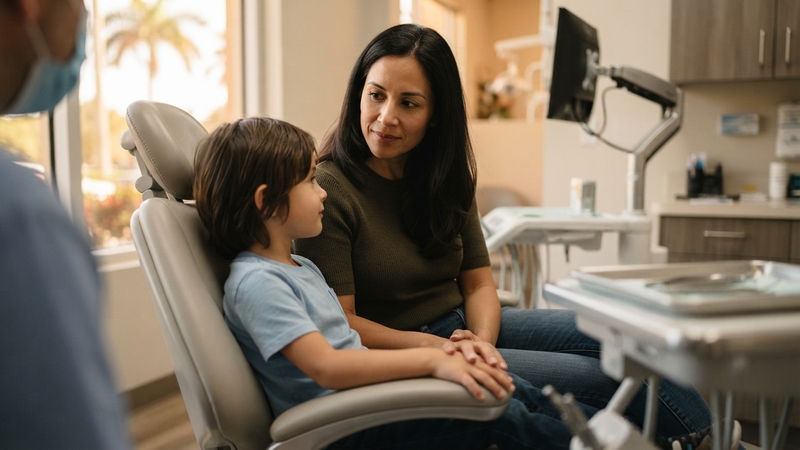
Finding the right orthodontic provider for a household with different ages and needs means looking past advertising and checking what a practice actually offers. A family orthodontist in Fort Lauderdale, FL should be equipped to treat a seven-year-old’s developing bite, a teenager’s crowded teeth, and a parent’s long-delayed desire for straighter teeth, all without sending anyone to a different office for each stage of care.
That kind of continuity matters more than most parents realize. Patients can benefit from a range of orthodontic services, including traditional braces, clear braces, Invisalign clear aligners, pediatric orthodontics, orthodontic appliances, and dentofacial orthopedics. When one practice covers that full range, families avoid juggling multiple providers as each child grows and treatment needs shift.
What a Family Orthodontic Practice Should Offer
A practice built for families needs more than a single treatment option. Look for these core services when evaluating a provider:
-
Traditional and clear braces for patients who need comprehensive correction of crowding, gaps, or bite issues.
-
Invisalign clear aligners for teens and adults who want a more discreet treatment path.
-
Phase I pediatric orthodontics to address developing bite and jaw issues in young children.
-
Orthodontic appliances, including retainers and palatal expanders, for cases that need more than braces alone.
Braces treatments include traditional metal braces and clear braces, so that patients can choose which option fits them best, along with ceramic braces that blend with the natural color of teeth, and an Invisalign system that uses a series of clear aligners to gradually shift teeth into their ideal position. Offering this range in one location lets siblings or parent-and-child pairs receive different treatments without switching practices mid-process.
When to Start Looking for Pediatric Orthodontic Care
Timing matters for children, and national guidance gives parents a clear benchmark. AAO experts recommend children complete their first check-up with an orthodontist by age 7, since around this age children have a mix of baby and permanent teeth, giving the orthodontist a wealth of information. According to the american association of orthodontists, this early exam does not mean a child needs braces immediately. It simply establishes a baseline so problems can be caught while the jaw is still growing and easier to guide.
A practice offering Phase I pediatric orthodontics can monitor a child from that first exam through any later treatment phase, which reduces the number of providers a family has to coordinate with over the years.
Comparing Orthodontic Treatment Options for Different Ages
|
Treatment Option |
Best Suited For |
Key Consideration |
|
Phase I Pediatric Orthodontics |
Children around age 7 with developing bite issues |
Early evaluation can catch problems while jaw growth is still active |
|
Traditional or Clear Braces |
Children, teens, and adults needing comprehensive correction |
Clear braces blend with tooth color for a less visible option |
|
Invisalign Clear Aligners |
Teens and adults wanting discreet treatment |
Aligners are removable for eating and brushing |
|
Orthodontic Appliances |
Patients needing palate expansion or retention |
Often used alongside or after braces or aligners |
What to Look for Beyond the Treatment Menu
Treatment options are only part of the decision. Scheduling, consistency, and communication affect whether a family actually sticks with a treatment plan. Consider these practical factors:
-
Same-doctor continuity. Working directly with the same orthodontist at every visit helps build consistency into treatment.
-
Flexible hours. Flexible hours, including evening appointments and Saturday visits, help busy households fit care into a hectic workweek.
-
Individualized planning. Building a treatment plan around what a person actually needs, rather than around a fixed schedule, tends to produce better results.
-
All-ages welcome. Practices that welcome patients of all ages, from children through seniors, let households addressing crooked or misaligned teeth get care under one roof regardless of age.
These details often matter more day-to-day than the specific brand of aligner or bracket a practice uses, since they determine how smoothly treatment fits into a family’s routine.
Frequently Asked Questions
At what age should my child see an orthodontist for the first time? National guidance points to age 7 as the benchmark for an initial evaluation, since that is typically when a mix of baby and permanent teeth gives an orthodontist enough information to spot developing issues early.
Can one practice treat both my child and me? Practices that offer pediatric orthodontics alongside braces and Invisalign for teens and adults can typically manage treatment for multiple family members at different stages.
Is Invisalign a realistic option for adults, not just teens? Yes. Clear aligners are commonly used by adults seeking a less visible alternative to metal braces, and they can be removed for eating, brushing, and special occasions.
What if my child’s bracket or wire breaks between appointments? Loose brackets or wires are a common and usually manageable issue; orthodontic wax can hold things in place temporarily, and the practice should be able to repair it at the next visit.
Choosing orthodontic care for a family works best when the focus stays on verified services, scheduling realities, and consistency of care rather than marketing claims. Practices offering a full range of treatments, from pediatric evaluations through adult Invisalign, give families room to grow without switching providers. Oceanside Orthodontics – Dr. Ovy Quintanal, led by Dr. Ovy Quintanal, provides this range of services for patients of all ages in Fort Lauderdale.